
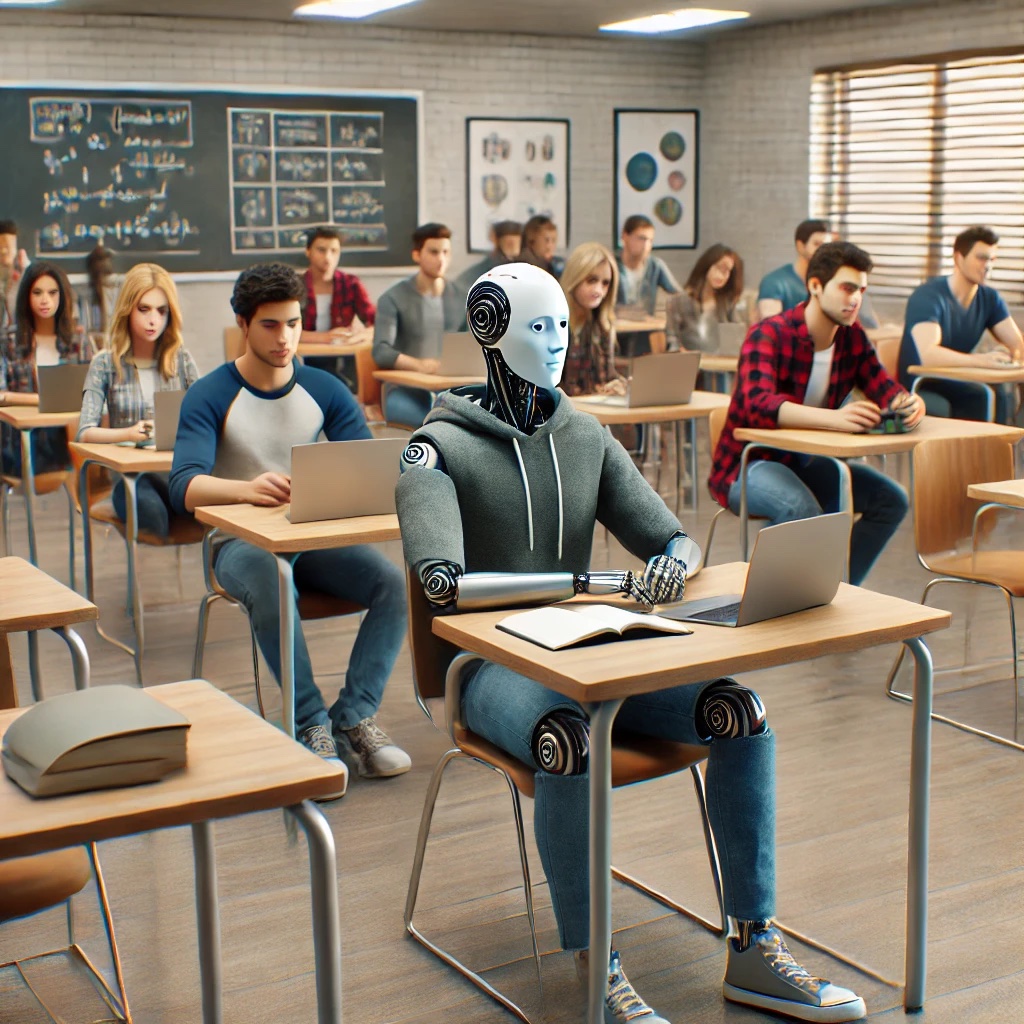
Image generated by DALL-E on 2024-09-02 by Luke Lara, prompted by “Realistic image of college classroom with students sitting at desks and one of the students is a robot”
By Luke Lara, Ed.D.
I have been working long enough in the California Community College system to remember all the paper applications students needed to fill out to enroll in college and apply for Federal Financial Aid. It was only thirteen years ago that the paper process eventually give way to an electronic process, with the promise of ease, convenience, and efficiency. The honeymoon period ended as criminal elements exploited technological advances and opportunities to easily, conveniently, and efficiently defraud the federal government and colleges of Federal Financial Aid.
The LA Times first reported on the California Community College-wide financial aid scam in 2021. At the height of the COVID-19 Pandemic the majority of California Community College courses were being taught online or remotely. Prior to the Pandemic, California Community Colleges offered most of their courses in-person or on-ground, with only a modest percentage of courses offered completely online. From 2020 onward, the opposite has been true, with 116 California Community Colleges varying in their approaches to find a new balance between on-ground and online course offerings. The heavy online environment we find ourselves in is ripe for continued fraudulent enrollments.
A statewide faculty advocacy group, Faculty Association of the California Community Colleges (FACCC), published an in-depth story on the magnitude of online bots in creating fraudulent enrollments through spring 2023. CalMatters, a California nonprofit and nonpartisan media group, emphasized this ongoing situation in April 2024 by sharing that California Community Colleges have lost more than $5 million to fake students.
Still, the story gets even more interesting, and it has not been written about anywhere yet. While colleges are becoming more proactive by employing mitigating maneuvers, criminal elements continue to evolve in their technological tactics. Admissions offices are having to assign more human eyes to review student applications, slowing down the enrollment process for the sake of ensuring real students enroll and fake ones are thwarted. Bots are now leveraging Artificial Intelligence (AI) to evade detection at the enrollment level and beyond.
A recent memo to faculty at the beginning of the Fall 2024 semester from Denée Pescarmona, Chief Instructional Officer at MiraCosta College, provided a glimpse into the next twist in fraudulent enrollments:
We have been flagging for review students who are registered in online only classes that do not align with their educational goals, as well as many other “flags” we have learned about in past work trying to eliminate these fake students. We currently have a new trend: fraudulent students adding an on-ground class to their schedule to try and bypass our existing mitigation measures. (Emphasis added)
Run that by me one more time? Fake students are now registering for on-ground courses? In addition, the memo stated:
We have received reports from faculty that they are receiving emails asking on- ground instructors to [teach] remotely [or] not be dropped for the first two weeks specifically using September 3 (after drop/census), as the date they will return to in-person class. These emails are not honest and are part of the larger scheme to defraud the college out of financial aid dollars.
On-ground, in-person courses use to be safe from virtual bots. This concerning trend continues to escalate, leaving one to wonder what it will take to block these fake enrollments completely. California Code of Regulations (Title 5) stipulates in §§ 58004 and 58161 the guidelines on how students are counted in credit courses for state apportionment funds. Fraudulent enrollments have significant financial implications to a college beyond the loss of financial aid money. California Community Colleges rely on their enrollments for subsequent year State budget apportionment. Having to recalibrate enrollment figures can jeopardize a college’s ability to secure the funding necessary to meet the needs of their actual students. A systemwide solution is necessary.
What is your college doing? Will we return to the ways of the paper application? I hope not, but paper may be the only way to unplug these fraudulent bots wired on AI.
 Lara Education Consulting