Stress less and Mindfulness

By Luke Lara, Ed.D.

Every three years I undergo a tenured faculty review process, which includes a self-study where I reflect on the previous three years. I enjoy reflecting and writing, yet I was dreading the next evaluation cycle. Back in 2019, I articulated a goal to introduce mindfulness to my department. This is a goal I set in 2019 and continued to set for myself in 2022. I had planned to request time at our department meetings and do a brief exercise. I also was going to explore organizing a group of counseling faculty interested in mindfulness to engage in regular practice as a community. None of that happened.

I had not anticipated a deep dive into leadership on campus that pulled me away from the department for several years. Simultaneously, the COVID-19 Pandemic in Spring 2020 upended the way faculty meetings would be held. Doing anything in community using a video platform such as Zoom is not the same as in person. Zoom fatigue was real!  We were burnt out from zoom meetings and zoom student meetings. It felt antithetical to have zoom mindfulness sessions. I waited, thinking the pandemic would subside and we would return to “normal.” It’s 2024 and most college meetings are still virtual, even though my remote work is limited. Back to the drawing board!

Mindfulness, the ability to be centered and present in situations that are stressful, is so critical at this time. It is an incredibly helpful tool to deal with technology, lead difficult conversations, and support colleagues and students. Life and work have become more stressful all around. Cultivating a practice of mindfulness is important so that when you find yourself stressed, its right there, ready to be put into play: a natural response in the moment.

I was first introduced to mindfulness as part of a leadership course in my doctoral program at San Diego State University in 2015. I have found both body movement and breathing exercises to be helpful in regulating my emotions, while developing empathy and compassion for myself and others. I have been excited to share it with others ever since.

Given that life is not slowing down and our new normal is hybrid, I created a series of 5-minute audio files so that colleagues can practice mindfulness on the go. Each mindfulness practice has a unique focus on body movement or breathing, while bringing awareness to and centering oneself in the moment.

In addition to a calming voice recording of a mindfulness exercise with instructions, each also have original background music to enhance a soothing effect. I am a musician and play various indigenous wind and string instruments from the Andes region of South America. The sounds are derived from various instruments, including the Quena (flute), Quenacho (large flute), Ocarina (novelty flute), and Charango (small 10-stringed instrument). Several colleagues have listened and reported the combination of Andean culture and voice has a transcending impact.

By engaging in this creative work, I am stressing less and hopefully providing that same opportunity for you and others.

Click on the links below to hear the currently available mindfulness recordings:

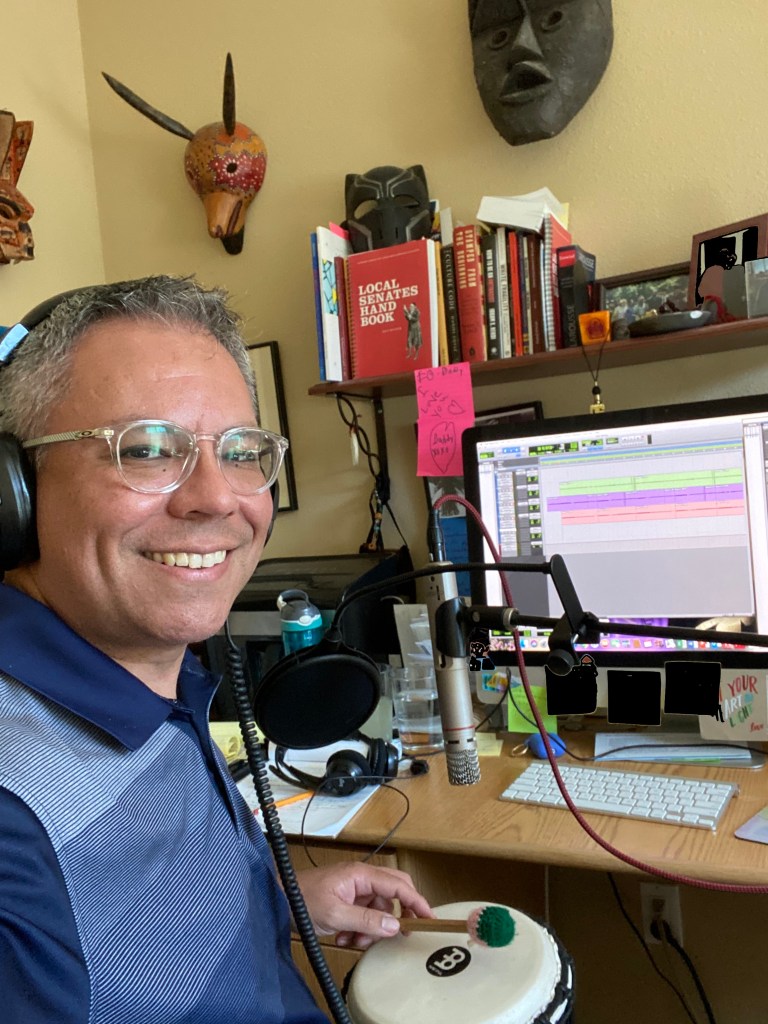
Behind the scenes having fun overlaying music with mindfulness exercises.

Next Big Twist: California Community College’s Fraudulent Enrollments Saga

A realistic college Classroom scene with students sitting at desks. One of the students is a robot. Image generated by DALL-E 2024-09-02.

Image generated by DALL-E on 2024-09-02 by Luke Lara, prompted by “Realistic image of college classroom with students sitting at desks and one of the students is a robot”

By Luke Lara, Ed.D.

I have been working long enough in the California Community College system to remember all the paper applications students needed to fill out to enroll in college and apply for Federal Financial Aid. It was only thirteen years ago that the paper process eventually give way to an electronic process, with the promise of ease, convenience, and efficiency. The honeymoon period ended as criminal elements exploited technological advances and opportunities to easily, conveniently, and efficiently defraud the federal government and colleges of Federal Financial Aid.

The LA Times first reported on the California Community College-wide financial aid scam in 2021. At the height of the COVID-19 Pandemic the majority of California Community College courses were being taught online or remotely. Prior to the Pandemic, California Community Colleges offered most of their courses in-person or on-ground, with only a modest percentage of courses offered completely online. From 2020 onward, the opposite has been true, with 116 California Community Colleges varying in their approaches to find a new balance between on-ground and online course offerings. The heavy online environment we find ourselves in is ripe for continued fraudulent enrollments.

A statewide faculty advocacy group, Faculty Association of the California Community Colleges (FACCC), published an in-depth story on the magnitude of online bots in creating fraudulent enrollments through spring 2023. CalMatters, a California nonprofit and nonpartisan media group, emphasized this ongoing situation in April 2024 by sharing that California Community Colleges have lost more than $5 million to fake students.

Still, the story gets even more interesting, and it has not been written about anywhere yet. While colleges are becoming more proactive by employing mitigating maneuvers, criminal elements continue to evolve in their technological tactics. Admissions offices are having to assign more human eyes to review student applications, slowing down the enrollment process for the sake of ensuring real students enroll and fake ones are thwarted. Bots are now leveraging Artificial Intelligence (AI) to evade detection at the enrollment level and beyond.

A recent memo to faculty at the beginning of the Fall 2024 semester from Denée Pescarmona, Chief Instructional Officer at MiraCosta College, provided a glimpse into the next twist in fraudulent enrollments:

We have been flagging for review students who are registered in online only classes that do not align with their educational goals, as well as many other “flags” we have learned about in past work trying to eliminate these fake students. We currently have a new trend: fraudulent students adding an on-ground class to their schedule to try and bypass our existing mitigation measures. (Emphasis added)

Run that by me one more time? Fake students are now registering for on-ground courses? In addition, the memo stated:

We have received reports from faculty that they are receiving emails asking ​on- ground instructors to [teach] remotely [or] not be dropped for the first two weeks specifically using September 3 (after drop/census), as the date they will return to in-person class. These emails are not honest and are part of the larger scheme to defraud the college out of financial aid dollars.

On-ground, in-person courses use to be safe from virtual bots. This concerning trend continues to escalate, leaving one to wonder what it will take to block these fake enrollments completely. California Code of Regulations (Title 5) stipulates in §§ 58004 and 58161 the guidelines on how students are counted in credit courses for state apportionment funds. Fraudulent enrollments have significant financial implications to a college beyond the loss of financial aid money. California Community Colleges rely on their enrollments for subsequent year State budget apportionment. Having to recalibrate enrollment figures can jeopardize a college’s ability to secure the funding necessary to meet the needs of their actual students. A systemwide solution is necessary.

What is your college doing? Will we return to the ways of the paper application? I hope not, but paper may be the only way to unplug these fraudulent bots wired on AI.

Six Tips for Effective Working Relationships

Photo by olia danilevich on Pexels.com

By Luke Lara, Ed.D.

A version of this article was published for my college union’s newsletter as “Reflections in my First Year as Ombudsperson.”

People First: A Guiding Philosophy

I recently read an article about how employees are increasingly seeking personal value and purpose at work. It made me reflect on my 16+ years as an employee at my community college, and whether I have succeeded in attaining personal value and purpose. The answer depends on the day you ask me. While my college offers an abundance of professional learning and growth opportunities to help me be my best self (purpose and personal value), I do not operate alone or within a vacuum.

I am a human being who needs to work with other human beings. I am a member of a department, a division, a college, and an extended district community. I interact daily with other faculty members, classified professionals, administrators, and students to conduct my work, provide services, and contribute to our institutional mission. I am lucky to work in a department that supports my personal development and values my contributions. However, others may not be so lucky.

I joined my college’s full-time faculty union as the Ombudsperson because I wanted to serve my peers. In this role, I help other full-time faculty resolve issues from a neutral, independent perspective. I have a counseling background and am accustomed to helping others navigate tricky situations. In addition, I received mediation training to improve my ability to facilitate difficult conversations. In my first year, I have assisted over 17 faculty by supporting and representing them through investigations, listening to their concerns, facilitating conversations with peers, and providing guidance and resources. One of the most common conversations I have is with faculty who believe they are being treated poorly by their supervisors and/or their faculty peers. Keeping in mind that the Omsbudperson must maintain strict confidentiality, I aim to share general guidance that could serve as a gentle reminder for all of us to be kinder to one another, which is based on a “people first” approach that prioritizes people’s wellbeing.

Institutional Code of Conduct

When issues arise that meet the board policy definitions of discrimination, harassment, and retaliation, the institution is obligated to investigate. The full-time faculty union is there to represent faculty to ensure rights and due process are granted and upheld. Unfortunately, I have found that there are many behaviors that our colleagues engage in that do not rise to those definitions yet cause much grief and turmoil for the faculty complainant.

Many institutions of higher education have an institutional code of ethics, which provides a foundation for expected behaviors that promote a climate that enhances the worth, dignity, potential, and uniqueness of everyone within the college community. These codes of ethics often outline expectations to maintaining effective working relationships and promoting an environment of collegiality. Everyone has a responsibility, as colleagues and supervisors, to adhere to the principles outlined in the institution’s code of ethics. The advice in the next section applies to all parties involved in a situation (e.g., complainants and respondents).

Six Tips for Effective Working Relationships

Human relationships take a tremendous, conscious effort to develop and sustain. Any important relationship will have tension. Conflicts often arise when there is a difference in perception, beliefs, and/or values. As we strive for diversity, there will be natural tension. It is when this tension goes unaddressed for a long period of time that an uncomfortable situation becomes unbearable. The following are tips for establishing, building, maintaining, and repairing effective working relationships, will help you avoid the unbearable:

  1. Assume nothing, communicate everything: It is easy to get caught up in our egos and get lost in our expertise. Why not? We are discipline experts. The climate in academia perpetuates this myth and doesn’t allow us to be vulnerable and truly develop community. A simple rule is to assume nothing and to communicate everything. For example, when interacting with your department colleagues, establish guidelines for how you will engage each other by developing them collaboratively as a group.
  2. Call-in: Lean into that natural tension and address issues immediately. Use a call-in approach by asking clarifying questions. For example, if a colleague made a comment that seemed to be a microaggression, ask: “Can you clarify what you meant by…” This gives the other person an opportunity to apologize or clarify what they really meant. This approach requires curiosity and follows the “assume nothing, communicate everything” guideline.
  3. Use I Feel Statements: “I feel” statements communicate how you feel to help minimize the possibility of defensiveness and conflict in conversations. The statement begins with “I feel_______,” which helps the listener focus on you, rather than themselves. The second part of the statement connects the feeling to an issue, “I feel _______, when _______.” The last part of the statement includes a desired solution, “I would like______.”
    • For instance, if you have a scheduling conflict with your supervisor you may say, “I felt like my needs were disregarded, when I was denied my request for teaching this class online. I would like some guidance from you on how to arrange my schedule so that I can better balance my home situation and work, while also meeting the needs of our department.”
  4. Take a step back: Honestly, sometimes it’s not necessary to engage in a difficult conversation. Take a step back and observe how you reacted to a particular behavior or comment someone made. What was your reaction about? If it was a strong reaction, it may have roots in something else. While this does not excuse the behavior or comment that this person made, it does point to a deeper issue you may want to explore individually before you engage with or call-in the other person. You may benefit from talking about your reaction with a third party to get some perspective and clarity before moving forward.
  5. Be aware of power dynamics and potential bias: Power dynamics underlie many of the issues I have encountered. The most obvious power dynamic is based on roles (dean, chair, department member). Other power imbalances exist between classifications (faculty, classified professionals, students). Less obvious are the power imbalances based on characteristics and identity (gender, race, ethnicity, etc.). It is important to acknowledge power imbalances and whether implicit bias is at play. Take a step back and check yourself with the following questions:
    • “Is there a power imbalance in this situation?”
    • “Do I react the same way to this person as I do to others in similar situations?”
    • “What biases do I have?”
    • “How might my biases contribute to my thoughts and reactions to my colleague?”
  6. The only person you can change is yourself: Through my counselor training, I learned a valuable life lesson. In both personal and work relationships, I often found myself expecting other people to change for me to feel comfortable in the relationship. Once I learned I had agency and could make choices for myself, I was empowered to change myself. I gave myself permission to reframe issues, forgive others if needed, and let go of what didn’t benefit me any longer. When I changed, I found others reacted to me differently and indirectly changed behavior in other people. Ask yourself the following questions, “Is this behavior/thought/emotion working for me?” or “Is this behavior/thought/emotion still benefiting me?” If the answer is no, then you can choose to let it go. What does it mean to let it go? How does it reframe your thoughts and feelings about the situation? Allow yourself to make mistakes and to grow as a human being.

While the tips above seem to place the heavy lifting on relationship building on the complainant, this advice applies to both the respondent and complainant. As the saying goes, “It takes two to tango.” Everyone is accountable to each other.

I hope this article is helpful in dealing with colleague and supervisor relations, but more importantly, let this article be a reminder to everyone to be kinder to one another. Listen to your colleagues when they call you in. Be open to feedback when you are a supervisor. Own your part in an issue and be accountable to seeking solutions together. If you take a people first approach, being kind is easy. Everyone is trying to seek purpose and value in their employment.

Futures Thinking in Higher Education – A Faculty Perspective

By Luke Lara, Ed.D.

During the 2021-2022 academic year, I participated along with about fifty students, faculty, staff, and administrators in a year-long futures thinking academy at MiraCosta College, Oceanside, CA. The sessions were led by Parminder Jassal, founder of the Work + Learn Futures Lab at the Institute for the Future. She is now CEO of SocialTech.AI, an organization the provides Practical Futures Advisory, to support development of “futures mind-set” in the education sector.

Several articles have been written about MiraCosta College’s involvement in this effort (see CCDaily and Insider Higher Education). As the Academic Senate President from 2020-2022, I was involved in shaping the faculty participation and narrative around futures thinking. Despite the volatile and disruptive pandemic during this timeframe, we recognized that developing a futures mindset would help us to better serve our students. I also had the honor of presenting MiraCosta College’s efforts around futures thinking at the annual American Association of Community Colleges (AACC) conference in New York, NY, in May 2022. Our goal was to encourage and invite other community colleges to join a collective and learn how to implement futures thinking.

At our fall 2022 all-college-day event, I was asked to present my perspective on futures thinking to all faculty, staff, and administrators. The following is adapted from my speech:

Buenos días, good morning. My name is Luke Lara, and I am the past Academic Senate President. I had the privilege last year to participate in the Futures Academy, along with other community members as a community of learners. To help you understand my perspective as a faculty member, I present you with the following image.

Photograph of a classroom with individual desks. Many desks have open laptops on them.
CC IMAGE VIA PIXAPAY

What does this image make you think of? I remember when I started teaching at MiraCosta in 2009. As many new faculty members do, I adapted elements of the syllabi of other faculty who had successfully taught the course for years. This included their classroom policies. One of the policies that I had on my syllabus was to ban or limit the use of computers and other electronic devices in the classroom. I believed, much like my colleagues, that these devices were a distraction to students and their learning. Look where we are right now. Computers, cellphones, and other electronic devices are ubiquitous in and outside the classroom. Now, many of us would agree that technology is necessary for the learning process. Had we used futures thinking, we would have been better prepared for this situation more than 10 years ago.

As faculty, we are lifelong learners. We are driven by curiosity and the pursuit of knowledge. Futures thinking allows us to harness our perception of what is on the horizon: what new behaviors, new services, new technology, and new ways of knowing of being. We call this in futures thinking: Signals. Futures thinking is not about forgetting about the past or living in the future. Futures thinking is about being in the present: understanding and being more perceptive about what is happening now that will impact our possible futures.

As faculty, we want to be proactive, instead of reactive. For example, in my experience, the week before classes start, I am scrambling to put together my syllabus. Maybe I’ve taught this course previously, and I already know what I am going to do. But, when we get into the classroom, as equity-minded educators, we must meet the students where we are at. We are always adapting. Could we have adapted before getting into the classroom? A futures mindset asks questions such as:

  • What is currently happening in the K-12? How may this impact us down the line, 5, 10 years from now?
  • How is climate change impacting our way of life and the pursuit of education?
  • What signals surround us that could help us see the possible futures?

Exploring the answers to these questions reflects the power of a futures mindset.

Futures thinking allows us to be collectively prepared for the student that will come through in 5, 10 or more years, instead of catching up on where we ought to be. For example, it feels like the equity movement in higher education is about catching up to where we should be. Had we used futures thinking, we probably would have been able to meet the needs for our students now and close the equity gaps that we have created.

Futures thinking allows us to develop curriculum and adapt our teaching and pedagogical approaches before we need to, not after.

Futures thinking allows us to engage as a diverse community of perspectives and lived experiences. This work is done as a collective, not individually. For example, faculty typically do their work independently with some opportunities as a collective, as a department, to think about and reflect on data. However, futures thinking requires a collective approach. Each of us has a different perspective. A futures mindset asks: What am I observing right now? What is happening in other industries that could impact how I do my work in the future? What do my colleagues see going on and what do they think? What do others see that may be interesting that I didn’t notice? As a collective, we bring together all these different observations (i.e., signals) and perspectives to inform a collective understanding of possible futures to help us move forward.

Lastly, at MiraCosta we are contributing to futures thinking globally. We are the first community college to have gone through a collective training and application to our planning processes. Our unique perspective of higher education, our deep understanding of our diverse communities, and application of equity will also benefit other industries’ use of future’s thinking.

Futures thinking is only a tool, one of many that we have in our toolbox. It is enhanced when it is used along with equity, racial, and intersectional analysis. It is important that we not abandon the tools that we are already using and are helpful. We must apply all our tools to enhance our work and what we do for our students.

This semester, we will be launching a Canvas course to facilitate the development of futures mindset and application of futures thinking to more members of our college community. I’ll be serving as one of the course facilitators. The course modules will be self-paced over a period of five weeks and culminate in a one hour zoom meeting to engage learners in a live community discussion. The hope is that a futures mindset will enhance our collective ability to be present-focused and future-oriented, as we not only meet the needs of today’s students, but are also prepared for the students who we will serve in five to ten years from now.

Mediation – A tool for Successful Relations

by Luke Lara, Ed.D.

Ever wonder why conflicts exist? I do not shy away from conflict, yet I’m not a fighter and my instinct is to freeze in intense situations (e.g., disagreements). However, I am willing to dive deeper to understand what is at the heart of the issue. At the crux of all conflicts is a difference of perception around resources, needs, or values, based on any number of factors such as beliefs, values, cultural traditions, religion, education, ideology, and lived experiences. Conflict is natural and when we are stuck in conflict, we may need a bit of help. Mediation or “facilitated dialogue” is a tool to support successful relations with others.

As a trained counselor, I developed strong great listening skills and the ability to help people problem solve. Counseling is often done with individual clients. Mine happen to be college students. Their conflicts were personal (e.g., negative self-talk, meeting basic needs, navigating college) or issues with others (e.g., a teacher, family member, employer). In contrast, mediation involves two or more parties. While mediation and counseling may share similar aspects, the goal of mediation is to reach agreement on future behaviors that address underlying needs and interests.

I recently completed a mediation training hosted by the National Conflict Resolution Center. They provided a week-long, interactive institute with highly skilled facilitators. I learned a great deal about mediation and how it can be an incredibly rewarding tool for bringing conflicting parties into agreement. Mediation, while a legal tool, has roots in collectivist societies (e.g., African Societies, Indigenous groups) as a means of justice and community healing. Mediation, at least in California, has the added benefit of being a confidential process.

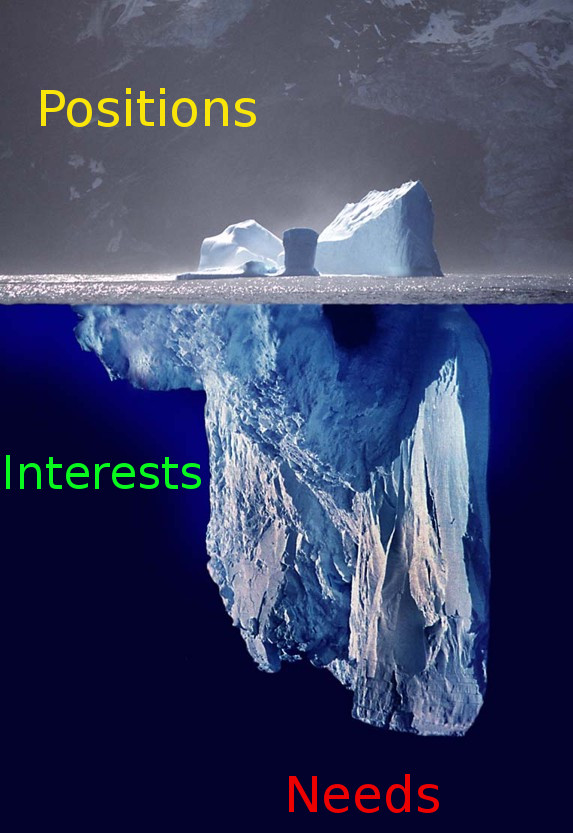
I’ll use the metaphor of an iceberg to illustrate what a conflict represents and how mediation can improve strained relationships. Imagine an iceberg representing a party’s perception of a conflict: a frozen piece of ice protruding from the cold ocean’s surface. Most of the ice formation lies below the surface. It may seem as though there are two icebergs set to inevitably collide (e.g., in the case of two parties). The protrusions represent the solid positions (e.g., statements) each party stands firmly upon (e.g., “We need to focus on Equity,” “I have a right to Academic Freedom”). Each statement seems mutually exclusive and completely in opposition. Yet, what lies underneath the surface are the underlying needs and interests that motivate these positions. By diving below the surface, we may find that the two seemingly distinct protruding tips are formed of a common foundation of needs and interests (i.e., the same iceberg).

Image: CC-by-sa 3.0 by Uwe Kils (iceberg) and User:Wiska Bodo (sky).

The real work of mediation is to understand the underlying needs and interests. The mediation process is not about changing people’s minds. It is about helping conflicting parties understand each other’s perspectives, identify the intersecting interests, and empower the parties to be future-oriented to find a resolution. Author William Raspberry wrote, “The opportunity for cooperation is there, even in our most vexatious disputes, if we’ll only bother to look for it.” In other words, if we look under the surface to understand the other party’s needs and interests, we may find an opportunity to cooperate. This is not to say that the interests are in common, but that through cooperation, a mutually beneficial resolution can be achieved.

A skilled mediator is a neutral party and facilitates dialogue while listening carefully, uses tools including, acknowledging feelings, identifying interests, summarizing/paraphrasing, translating, identifying expectations, caucusing (e.g., private meetings), and asking questions. Mediators must set a tone of hope through neutral language that reframes and builds connections. Through facilitated dialogue, mediators become the conduit through which communication is jumpstarted and nurtured, helping the parties stay resolution focused.

Mediators facilitate the process, and the parties are responsible for the content. A well-facilitated dialogue can empower the parties to creatively address their issues and come to an agreement on future behaviors through SMART (specific, measurable, achievable, relevant, time-bound) goals. Not all mediated issues result in a resolution. However, the communication skills learned in the process can still help those involved grow as a person, employee, and/or a leader. The parties can always agree to enter mediation again later.

Don’t let conflict stop you from preserving important relationships (personal or professional). Let mediation help you before issues escalate. It helps if all parties are willing to engage in the mediation process. Next time you have a conflict with a colleague, a neighbor, a friend, or a family member, consider a neutral mediator to facilitate a dialogue. Many employers, city offices, and community groups offer free or sliding-fee-based mediation services.

Resources:

Academic Leadership in the Time of COVID

"COVID-19 - The year of the virus" by joncutrer is marked with CC0 1.0
“COVID-19 – The year of the virus” by joncutrer is marked with CC0 1.0

by Luke Lara, Ed.D.

Part I: How it Began

One year ago this week, I began my journey as the Academic Senate President. It also happened to be a few days after the death of George Floyd and right before the pandemic began a second wave in America. Our local Academic Senate usually does not meet during the summer. I thought: How should I respond? What do the faculty expect to hear from me? It did not take me long to decide what to do.

There were many ways I had imagined embracing this important role; however, entering a quickly and ever shifting world of remote education and reckoning with systemic racism were not on my mind three years earlier when I ran for vice president and then president-elect. The latter I was well prepared for, but the pandemic certainly exacerbated it and forced a racial awakening for everyone, everywhere.

I had just finished a year of consulting with the Academic Senate for California Community Colleges, collaborating with various constituency groups, writing papers, and doing presentations across the state. I made contributions to moving policy and discussion around student success, equity-driven systems, anti-racism, equity in hiring, and faculty diversification and retention. Equity, anti-racism, and naming systemic racism were at the root of my writings and presentations.

My initial reaction was to take this opportunity to address the faculty. Everyone was on break. I did not know what to expect. I sent a letter to my faculty colleagues on 5/30/2021. It contained a personal message to introduce myself, a uniting message in the face of chaos, and resources for action including allyship training, anti-racism resources, petitions, donations, mental health resources for the Black community, and organizations for those who want to get involved.

Excerpts of the letter are here:

  • …This is not the way I imagined my first email to our community as the Academic Senate President during my first week in this role. I write with a heavy heart and tears in my eyes. While many of our own Black faculty, staff, and students are mourning their loved ones as a result of the disproportionate impact that COVID-19 has had on the Black community, they are also grieving in unison for the victims of police brutality, their families, and communities. The recent police violence and hate crimes against members of the Black community (Breonna Taylor, George Floyd, Nina Pop, D’Andre Campbell, Tony McDade, Regis Korchini-Paquet, and Ahmaud Arbery) have seared a pain that has reverberated across the nation.
  • …Diversity, equity, and inclusion are buzz words for most, but these terms carry a spirit that has defined how I embrace life and how I move in this world.
  • …Given that we will remain in a mostly distance education format for the summer and fall, it is important that we engage purposefully as a community. I urge us to be race conscious, to be equity-minded, and anti-racist in what we do, teach, and how we enact our roles.

Part II: What has Developed

We met on June 25, 2020, in a special meeting of the Academic Senate to review, discuss, and approve a resolution of the Academic Senate: Declaration that Black Lives Matter and a Call to Action. Throughout this past year, we have steadily implemented changes based on this resolution. The following are examples of implemented changes:

  • The Academic Senate surveyed BIPOC faculty to learn about the faculty experience of the tenure process and institutional retention efforts. A taskforce gathered the survey results and presented recommendations to the Academic Senate in May 2021.
  • The Academic Senate’s subcommittee on Diversity, Equity, and Cultural Competency created a joint taskforce with the Tenure Review and Evaluation Committee to make recommendations to changes to the tenure review process, evaluation criteria, and training.
  • The Academic Senate worked closely with the administration to create a Student Conduct and Police Advisory Committee in the fall of 2020. The charge of the committee is to review data on campus police interactions with students, give guidance on restructuring of the police department, and make recommendations to policies and procedures.
  • The Academic Senate subcommittee on curriculum, the Courses and Programs Committee, have steadily reviewed policies and procedures around the philosophy of the associates degree to make changes that are equity based (pending approval), including: allowing the use of “C-” grades for major courses, reducing the number of units required for the science general education area, and reducing the number of units required in general education for the high unit Nursing degree.
  • Professional development partners, including inter-college groups, our online educators’ group, our teaching and learning center, and others, have been creating, facilitating, and sharing opportunities locally, state-wide, and nationally with all faculty on topics ranging from anti-racism and equity in online course delivery, curriculum, teaching, and student engagement. Faculty have been inspired to create discussion groups to discuss race and racism. Two faculty leaders have coordinated a formal group of 12 faculty during a year-long journey to review their own curriculum and teaching practices through an equity lens. This group is called the Cultural Curriculum Collective.

All of the above, unfortunately, would not have been possible within one year if the tragedies of our Black community have not happened. We are only just beginning to make transformative change. Before I get burned out, I need to take a step back, take a deep breath, and be mindful in this moment.

Part III: How I Sustain a Forward-Attitude

In the academic world we talk about GPA’s all the time, but one thing is for sure, my GPA has strong this past year. No, I am not talking about an academic GPA. I am talking about having Gratitude, Patience, and Adaptability. I want to acknowledge that my colleagues have demonstrated a strong GPA and resolve this year and we were only able to accomplish the above list as a collective. So, you could say that our cumulative GPA is what allowed us to be successful.

I am grateful to all of my colleagues. I have seen us work together, complain together, brainstorm together, laugh together, and still be focused on what’s most important—our students.

I have learned to be more patient and to practice mindful breathing. As many of you may have experienced, I am not only working at home, but I am teaching my children, being responsive to important relationships in my life, being anti-racist, and also trying to stay mentally and physically and healthy.

Lastly, I am completely in awe of our adaptability to the changes that this past year has thrown us. In 2019, we could not have imagined what it would be like to offer the majority of our courses through distance education, conduct our work remotely, or even begin to decolonize our institutions or even have campus-wide discussions about race. But here we are!

This is not a moment. This is not a blip. We have embarked on a journey that will lead to healing and transforming practices and policies. We cannot go back to how things were in 2019. That was the past. I look forward to reflecting again in a year from now when my presidency ends. Until then, join me in sustaining our collective GPA through community. Equity work is hard. Transforming systems and institutions is hard. Yet, we can do it together. ¡Si se Puede!

The Poetry of Diversity and Inclusion

by Luke Lara, Ed.D.

Poetry is one of the many ways I lose myself, reconnect, and feed my creative side. Few people know that I write poetry or that I compose music. These creative outlets allow me to tap into my emotions, spirituality, and ancestral guides.

Lately, I have written several blogs on equity, diversity, and inclusion. These concepts in action (or inaction) cause folks to feel stuck, energized, exhausted, and confused. Our institutions can be advancing forward or backwards.

Below are two poems I have written that convey my own personal emotional journey with these terms and how they operate in higher education and beyond. Enjoy and contemplate.


Diversity in a Checkbox Nation
 
Check
 
Check
 
Check
 
Check
 
Black               White              Hispanic          Ecuadorian
                      And everything in between
 
Nobody dares ask me “Who are you?” or “¿Quíen eres?”
            only anonymous and optional forms
care to ask
            in multiple languages too
 
Potential employers do not greet me in mi idioma natal and
they cannot ask about my race,
sexual orientation,
religion,
                        national origin,
                                    gender,
                        political affiliation . . .
                                    but their intake surveys can
 
I want the job because of WHO I am
            yet
                        they
                                    cannot
                                                hire
                                                            me
because of who THEY think I am
 
The census is no better
The government doesn’t care about ME
Los sin vergüenzas only want my data
My male Latinx Black and White cishet mishmash ass
is just
another point
among all the data
 
What would it cost someone to ASK me “Who are you?”
            What would it mean for someone to LISTEN?
                        At what point will we stop seeing each other as data?
                                    When will the system care about ME?
 
What connects us is not data
                                                            What brings us closer is our stories
           
Sin miedo – without fear
            share your story
                        and ask others to compartir - share
            listen without interruption
                        with full respeto


                        Accept their story
                                    for their story is theirs and theirs alone
                                                we could never know it
                                                            except if we listen
                                                                        and we find the rhythm
                                                            of
                                                humanity
                                    that                             que
                        runs                                                     corre
            deep                                                                            profúndamente
within                                                                                                  por dentro
 
So, now you are ready to listen to my story
            Who I am
                        What my purpose is in life
                                    And why I am here
                                                Sharing mi historia with you
  One & the Same
 
I have been searching
for the elusive one we call
DIVERSITY
 
Have you seen them?
 
Yes, Diversity is plural,
            a cosmic and radiant group
They are hard to miss
look at any college website
            or company brochure
Everyone seems to love Diversity,
            embrace Diversity
 
Yet, when I visit that college campus or business
I ask, “Where did diversity go?”
 
They tell me,
            “Oh, there she is”
            or, “That’s him right there”
 
Diversity is no longer plural,
no longer cosmic
or radiant
 
Diversity looks dull,
            demoralized,
                        burned out,
                                    tired of being singular
tired of being alone
            tired of the world of isms
 
I still have hope that I’ll see them again,
somewhere
 
Now, I search for Inclusion
They are certainly plural
            And related to Diversity by blood
 
You may have seen Inclusion
They tend to be in positions of power,
or at least they are valued stakeholders
I ask,
 
“Where might I find Inclusion in this organization?”
 
They point to her
 
I blink my eyes,
adjust my glasses,
and I see a familiar face
It is singular Diversity again
 
I ask,
“But, where is Inclusion?”
 
            No response
 
Head hung low
I walk away
 
When will we know true Diversity?
 
When will we honor true Inclusion?
 

The Accidental Doctor with a Passion for Hiring Practices

By Luke Lara, Ed.D.

I came to my office on June 5, 2015 and found a note on my chair. It said, “Dr. J. Luke Wood is looking for you. Give him a call at…” I recognized the handwriting and went to find my colleague with the distinct print. Why would Dr. J. Luke Wood be looking for me and why did he contact my colleague? Confused, I asked my colleague, but he just shrugged his shoulders. Minutes later, I dialed the number on the post-it note. That was the beginning of a whirlwind three years of my doctoral program.

A month earlier, I had attended an Equity Summit at a local hotel in Carlsbad hosted by my college’s Student Success governance committee. The keynote speaker was Dr. J. Luke Wood of San Diego State University (SDSU). He also happened to be the Director of the SDSU Ed.D. program. He discussed his latest research on men of color in community college. I remember how this was the first time I had heard of such research and felt excited to learn more. After the presentation, a colleague introduced me to him. I expressed interest in Dr. Wood’s research. He asked me, “Have you considered getting a doctorate degree?” I replied, “You know, I applied back in 2009 and was accepted to the program, but because I had just been offered a full-time tenure track position and had a newborn son, in consultation with my partner we decided I could only do one or the other.” I continued, “At the time, getting paid was the logical choice.” To that, he retorted, “Would you apply again?” Was he calling my bluff? I felt the pressure to say yes. I jokingly replied, “Would I have to take the GRE again?” It had been 10 years since I had taken the GRE and the anxiety lingered. After what seemed several moments of thought, he surprisingly said, “No.” Our conversation ended with me saying with a smile, “Okay, then I’ll think about applying next year.”

I identify as Latino, specifically Ecuadorian, and as male. I am mixed racially, Black and white. I grew up in Minnesota, only knowing Ecuador through my childhood home on Main St. in the suburb of Columbia Heights. I spoke Spanish and learned English as an ESL student in the local public school. The local parochial school would not accept me if I did not speak English. My mother, white and college educated, and my father, middle school educated and Afro Ecuadorian, lived on welfare for most of my youth. What they lacked in material wealth, they made up for in cultural and moral richness. My parents were musicians and social justice change agents. They organized and educated the community around social justice issues. They valued the dignity and worth of every human being, and especially fought for the most marginalized. I embraced their values, and these have been challenged every day of my life. I experience life as a brown man in a society that sees me as inferior, despite my intelligence and credentials. This is my worldview.

The year 2019 marks my twentieth year working in higher education. In my first six years, I worked in private and public four-year colleges and universities, specifically with students of color and first-generation college students. In particular, I directed a federally funded program called TRIO Upward Bound Math and Science for three and a half years. We promoted STEM and higher education to high school students in San Diego and Imperial counties who were low income and would be first-generation college students. Given the borderland context, the majority of the students were Latinx. As a requirement of the federal funding, we had to track students from High school graduation through bachelor’s degree achievement. All of my students graduated from high school and the majority of them went straight to a community college. I had no clue as to what this meant at the time. I had the privilege of attending a private liberal arts college in the Midwest and graduated in four years. I attended the public K-12 system in Minnesota and only experienced a maximum of 500 students in my high school and only 1,800 students in college. When I first stepped foot on El Cajon High School’s campus nearly 18 years ago and learned there were more than 2,000 students, I could not believe it. Community colleges in San Diego county have varying sizes, but many are between 10,000 and 20,000 students. Community colleges were known as “2-year” colleges: a place where students could prepare to transfer to the 4-year college or university. Curiosity to learn more about why my students continued to be at the community college beyond two years led me to earn a master’s degree to become a counselor in California’s community colleges.

When I first entered the community college world in 2006 as an adjunct counselor, the big focus was on the basic skills initiative. I was very involved in many innovative projects to support basic skills students. I began to understand the trend I had been seeing in my TRIO data. Students, in particular, students of color, low-income students, first-generation students, were stymied in the community college through low English and/or math placement. They often started two or three levels below what was required for successful attainment of an Associate’s degree or transfer to a four-year college. Their journey became too long and full of institutional and life obstacles.

I knew I could do more as a full-time counselor to establish the necessary relationships with students and colleagues to change the system. However, several counselors warned me that it would be ten years before I was offered a full-time tenure track position. I took that as a challenge. I hustled. At one point, I worked at five different colleges and universities teaching and counseling. I looked at every possible opportunity, including the newly created doctoral program at SDSU that emphasized community college leadership. My life was converging upon itself: a newborn son, a full-time faculty position, and admission to a doctoral program. I made the right choice at the time. I now have two wonderful children that are 10 and 8 years old. I am tenured and I have held many leadership roles in my department and institution. I am grateful for the growth in those six years before the portal of the doctoral program reopened to me.

For four of those first six years of full-time employment, I led the Puente Project, a transfer success program based in culturally relevant teaching and culturally sustaining pedagogy, emphasizing the Mexican American/Chicanx experience in California. I witnessed first-hand the impact of culturally responsive curriculum on the growth and development of Mexican American/Chicanx students. For many, this was the first time they had a teacher who acknowledged their identity as a strength for learning. It was the first for many things: first time reading Latinx, Mexican American, or Chicanx authors; first time being taught by a Latinx identified professor; and, first time being validated as college worthy students. My college success course was taught in conjunction with an English course as a learning community built on the foundation of a cultural community. My Puente partner and I intentionally engaged with our students in each other’s classrooms and outside the classroom, creating a community of support and “família-like” community.

Meanwhile, I also served as department chair for two and a half years. In this capacity, I hired over 20 adjunct faculty. I also had the privilege of chairing four full-time faculty search committees, resulting in seven hires in my department. Lastly, I have served as a member on several search committees within my department and outside my department, including committees for two vice president searches, one dean, a math faculty, a computer science faculty, a department secretary, and a student support specialist. I approached each of these searches with curiosity, always seeking to hire people that could truly support and understand the student diversity at the community college. I did not have a word for it at the time, but now we refer to this as seeking “equity-mindedness” in a candidate. That is, the ability to be culturally responsive, social justice, and equity focused to support our most marginalized students in achieving equitable outcomes.

In 2015, when I saw Dr. J. Luke Wood’s presentation, I had an epiphany. As he talked about better supporting our men of color, I asked myself, “Who are we hiring to support our men of color?” What happens in the classroom begins with who we hire. Who we hire is dependent on the institution’s values, vision, policies, leadership, and agents (e.g., the people involved in the hiring process). This train of thought fueled my quick affirmative response to Dr. Wood when he called me a month later. Coincidentally, the topic of diversifying the faculty had also intrigued the state chancellor’s office in the fall of 2015, and later the Academic Senate for California Community Colleges in subsequent years. My intuition was right on.

During the first day of orientation for the doctoral program, we met all the faculty. We spent about five minutes with each one for a “speed dating” activity, where we introduced ourselves and our topic of interest. Most of the cohort were interested in studying students; student athletes and transfer; foster youth in community college; formerly incarcerated students; or Latinx students in STEM. Two people were interested in studying leadership.

As I met faculty members to explain my proposed topic, there was mostly mild to low interest. My topic did not align with studying student success directly. Fortunately, I was not dissuaded, and I found a dissertation chair that believed in me. Dr. Felisha Villarreal Herrera, a newer faculty member, had just started her third year at SDSU, but had previously been a tenured faculty member elsewhere. While her focus was on Latinx students in STEM, she and I found common ground as I developed my guiding theoretical lens, critical race theory (CRT). I was fortunate to have her as my writing instructor in my second year, where she helped and encouraged me to apply CRT to my topic. I had heard from other classmates that other program faculty frowned upon the use of CRT, so I felt very fortunate to have a mentor that understood my inquiry.

To start, after the orientation, I embraced the daunting task of reviewing previous scholarship. I started off broadly, looking at hiring practices in education, hiring discrimination, racial discrimination, cultural competency, and implicit bias. I found and applied articles from various fields including education, business, sociology, social work, psychology, history, and law. I expanded my literature review with every new article I read, exploring every branch of the tree. The branch for higher education on hiring practices was thinner than the branch for K-12. In comparison, the research on community college hiring practices was a small twig.

I adopted CRT as a guiding theoretical lens by which to analyze what I had gathered so far. It provided a framework to understand discrimination in the hiring process. While discrimination is multidimensional, I focused on racial discrimination because it has been an enormous challenge over the last thirty years to racially diversify the community college faculty. When we consider state and federal non-discriminatory laws and affirmative action, it becomes even more daunting to improve hiring outcomes. However, the more I read, the more questions arose for me. Three years went by quickly. They were accompanied by my institutional praxis and professional development throughout that period that acted like fertilizer to my growth: the twig was going to get longer, stronger.

The most rewarding part of writing the dissertation was honoring my participants by writing and sharing their lived experiences. I engaged in a phenomenological inquiry and interviewed ten community college faculty of color who actively advocate for hiring faculty of color on faculty hiring committees. The whole process was emotional for me and the participants. They shared stories of what they see as barriers in the hiring process and how they strategically disrupt those barriers. I do this work for them and all the students of color who come through our community colleges and who we hope to hire one day as faculty.

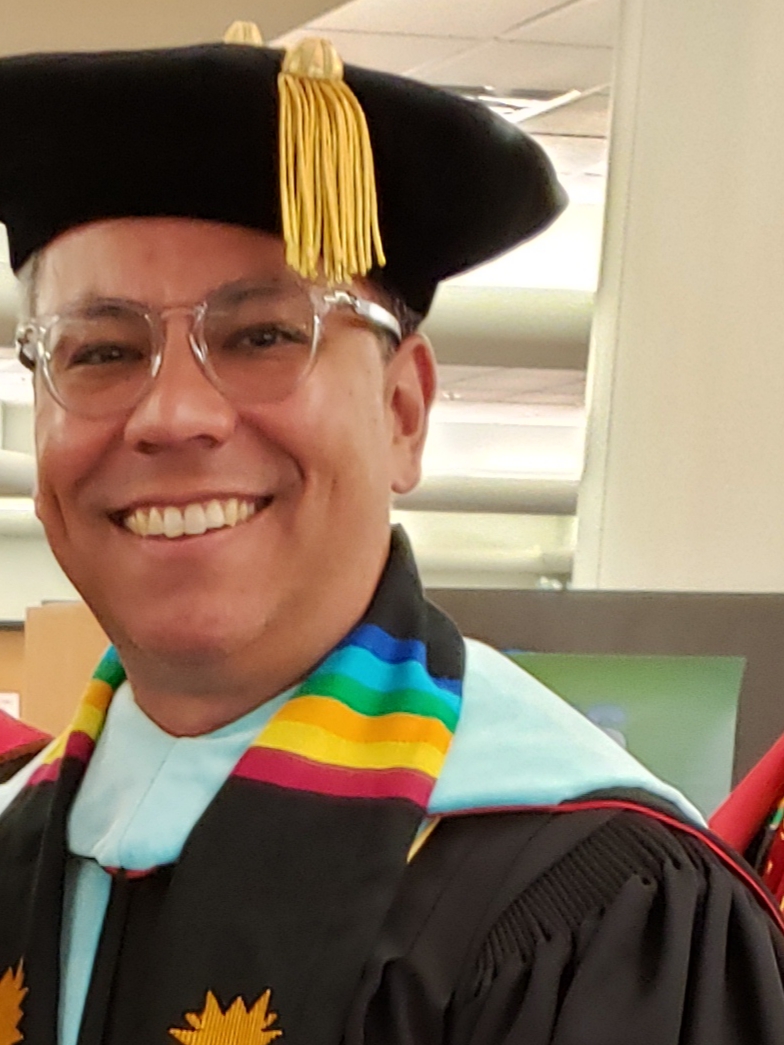
As I sat on a wood stool to be hooded by Dr. Felisha Villarreal Herrera in May 2018, I felt the weight of what I had embarked on, with my parents in the audience—roots—and my partner and children cheering me on—future. When we first started, I was told, “You will become the expert, the one and only person who will know what you know. That is what it means to be a doctor.” One year later in April 2019, I published an article based on my dissertation in the prestigious Community College Journal for Research and Practice. In this past year, I have presented at state-wide sponsored events, presented at other community colleges, and trained faculty and HR professionals. Am I an accidental doctor? Given my origin story and professional experiences, this is not so accidental but rather exactly what I need to do, when I needed to do it. I am intentionally here to change paradigms, improve hiring outcomes, and create equitable student success outcomes for our students of color.
CRT and the Tensions between Diversity, Equity, and Inclusion – What Leaders Need to Know

By Luke Lara, Ed.D.

Diversity, equity, and inclusion are often conflated. These are three separate concepts that are inextricably connected. Many leaders confuse these terms, treat them as one concept, or only focus on one at a time. A great leader will work on all three at the same time, understanding the nuances of how they interrelate, and engage in equity-minded practices. – June 2018

I want to further reflect on the natural tensions between these three concepts.

More colleges are beginning to explicitly value diversity, equity, and inclusion in mission statements and board policies. Many are genuinely changing procedures and practices to transform their institutions to truly reflect the diversity of their communities, create equitable outcomes, and foster inclusivity. Few know how to achieve these goals: move from written policy to social justice in action.

To better understand and acknowledge the tension and often contradicting nature of these three concepts, we need to apply a critical framework. For example, critical race theory acknowledges that race and racism are ubiquitous and are problematized even more when looking at the intersectionality of race with class, gender, sexual orientation, and other identities; it challenges the dominant ideology; and it centralizes the experiential knowledge of those who are oppressed. Applying CRT, we can then ask interrogating questions to understand the complexity of these terms. The current dominant ideology centers the white, heterosexual male. It is through this dominant ideology that diversity, equity, and inclusion are traditionally defined.

Diversity refers to representation based on myriad individual/group identities (e.g., counting the population). We should ask ourselves: As we add different people to the group, at what point is the group diverse? How many women do we need? How many people of different racial and ethnic backgrounds do we need? A common myth is that diversity is a zero-sum concept. For example, if we were to hire more African Americans, then this inevitably means we hire less of another racial group (i.e., white people – those at the center). This misconception stokes fears of “reverse discrimination” or “bias” from the dominant majority, which contradicts their own orientation of inclusion. Proponents of diversity argue, as I do, that representation needs to be responsive to historic and contemporary needs of the community that is being served. For example, if your institution is designated a Hispanic Serving Institution (HSI), and your Hispanic student population is 33%, then there should be at least a proportional representation in the faculty, staff, and administration of that same demographic. By the way, a white person actually asked me this question, “Does this mean the institution should not hire more white people?” No. What it means is that the institution should be gathering and evaluating data and being responsive to the rich diversity of its community. Decisions will need to be made to increase the diversity of faculty, staff, and administrators. Also, it may have been acceptable thirty years ago to hire someone who is “sensitive” to diversity, but current equity gaps and inclusion efforts require higher standards, beyond sensitivity.

Inclusion is the notion of welcoming all people. It implies that “others” are “allowed” to participate. The dominant group still controls the rules and the culture of the group or organization. However, from a CRT perspective, it means that everyone in the community has a meaningful opportunity to contribute to the decision-making and learning process. Thus, a new ideology is created through a collaborative process, uplifting formerly marginalized voices and experiences and centering them in the process. In relation to hiring, being inclusive means that the composition of the search committee not only has a meaningful representation of racial and ethnic members, but that each of these members is respected and whose contributions are validated and equally weighed alongside those of others (i.e., white members). The token person of color on the search committee is indicative of a diversity framework centered in the traditional definition of inclusion. An inclusion framework expands on diversity to truly create the conditions and culture within the search committee to allow for meaningful participation and perspective. For example, an inclusion framework allows for a diversity of perspectives to engage and challenge the dominant ideology, thus allowing a new and co-created culture.

While diversity and inclusion can be superficially achieved, it requires conscientious effort and action to achieve equity (not to be confused with equality). The PolicyLink research and action institute define equity as, “Just and fair inclusion into a society in which all can participate, prosper, and reach their full potential.” Equity work is about removing barriers. It is about possessing equity-minded competencies such as being culturally competent, implementing race conscious principles, analyzing disaggregated data, approaching equity systemically, and taking responsibility as an institutional agent to remove barriers. In this respect, equity-mindedness is a characteristic that can be learned; a skill that can be assessed. Equity work leads to results that transform students, institutional agents, and institutional structures. If we are looking to change inequities, we need to apply an equity framework to address historic and contemporary issues for our diverse student populations. This work is both individual (e.g., practices) and institutional (e.g., policies, procedures). This work can be practiced by anyone, regardless of racial or ethnic background. Someone asked me, “So, when it comes to hiring, does this mean that we don’t need to worry about diversity? No. Although the concepts of diversity and equity are seemingly different and contradictory, they in fact interact. For example, while the race of an applicant should not be the determining factor of whether they should be hired, a search committee that seeks equity-mindedness will more likely hire a candidate that is not in the dominant majority (i.e., white) based on equity-minded competencies.

In education we are very concerned with the performance of minoritized student groups. We tend to frame education through a liberal lens, where everyone is treated equally, and everyone has the same opportunities. Yet, the reality is that minoritized students are not experiencing the same outcomes. In another example, if we look at the racial diversity of faculty in higher education, we see that despite the commitment of colleges and universities to diversify their faculty, there is little success of the past several decades to significantly increase racial representation. In both cases, we frame the problem around diversity. That is, we blame the outcomes on the minoritized students and faculty. Dr. Estela Mara Bensimon makes the case to reclaim the racial justice meaning of equity, because this will allow us to reframe these racial issues through a racial action-oriented and systemic approach. She states that race is missing in equity conversations and definitions because leaders take an “ALL! Students matter” approach and avoid discussing race, even when the data clearly show a racial opportunity gap in outcomes.

While it is all the “buzz” to say “Diversity, Equity, and Inclusion,” think twice before you string these three words together. I have noticed that some college leaders have created the acronym DEI to further conflate these concepts, which ignores their tension, and simplifies their significance. We tend to create acronyms in higher education, which is detrimental in this case, if leaders do not fully comprehend these terms. Understand and acknowledge the tensions between these terms. The three concepts can coexist and help you achieve your goals, but there are too many misunderstandings around these concepts to effectively advance your mission. Clearly communicate the complex nature and relationship of these three concepts to your constituents. Utilize a critical framework to interrogate these concepts. Help everyone understand the differences between these concepts and how these three concepts will strengthen your capacity to serve your community.

Fatal Flaws of Equity Work in Community Colleges – What Leaders Need to Know

fatal flaw

by Luke Lara, Ed.D.

When I go shopping for eggs at the local grocery store, I open the egg carton and check every egg. If I find one that is ever so slightly cracked, I put the carton back and begin the search process all over again. One time I went through my routine, bought a dozen eggs, and returned home. The next morning, when I took out an egg, I discovered that there was a very long and obvious crack along the bottom of the egg. I had not lifted and checked each egg at the store. I had only observed the top halves. My fatal flaw was that I did not check the underside of each egg. Luckily, I learned my lesson, avoided salmonella, and have modified my routine.

In this blog I write about my personal observations of leaders in regard to issues of equity (for students and employees). I describe three fatal flaws and provide examples for each one. A fatal flaw reflects a crucible moment in which a leader displays anti-equity mindedness attitudes or behaviors, thus disorienting the equity momentum or movement at their college.

Fatal Flaw #1: All Lives Mattering Issues of Equity

Most community college leaders agree that diversity, equity, and inclusion are worthy goals. In California, there are funds dedicated to improving the retention and completion rates of our students. Colleges have to create and submit a detailed plan of how the funds will be spent. Colleges were asked to identify student populations (e.g., race/ethnicity, gender, age, veteran status, socio-economic status, disability) that experience disproportionate impact in areas of access, course completion, basic skills, transfer, and degree attainment. Once a group is determined to experience disproportionate impact, an intervention and plan is created for the specific student group and area. However, we make the fatal mistake of arguing that the resources should provide equity for all students. This is akin to detractors from the Black Lives Matter movement insisting that “all lives matter,” whose claims negate the disproportionate number of unarmed black and brown bodies murdered by police. Institutional data indicate that not all students need more resources to succeed. For example, there is disproportionate impact experienced by Black, Latinx, and other racial and ethnic groups at the community college. Therefore, we must boldly and directly address race, racism, systemic racism, and White Supremacy. When we “all lives matter” issues of equity, we conveniently ignore issues of race, which also intersect with gender and socio-economic status.

Bottom line: Leaders, lead bold discussions about race, racism, systemic racism, and white supremacy. You may not be the expert, but you are the leader. Reach out to those that can help you deliver the message to the various constituencies on campus and off-campus. Avoid “all lives mattering” equity work.

Fatal Flaw #2: Not Protecting the Community

Free speech is a hugely debated topic in higher education. Many college leaders hide behind the rhetoric of protecting free speech, while alienating students and employees affected by vile speech (e.g., not harsh enough to be a hate crime, yet enough to create harm to the community). In many instances, these leaders’ responses are reactionary and are often done because an internal community pressures the administration for a response. Leaders and institutions of higher education are averse to negative publicity.

The University of California, Santa Barbara is a great example of how a university has been proactive in an age of hate. In the summer of 2016, campus leaders came together to discuss creating a discourse campaign that would be a positive and proactive measure in the heat of the presidential election season. They called it: “Resilient love in a time of hate.” As soon as student leaders arrived in the fall of 2016, they were incorporated into the development and implementation of the campaign. A series of events were created with renowned scholars, artists, and leaders. Stickers and shirts were printed. The campaign sought to promote conversation and creative work forged in a love-driven response to hate, hurt, and fear. I heard about this at the National Conference on Race and Ethnicity (NCORE) in higher education. The workshop presenters shared multiple stories of how issues of free speech were supported, while creating an environment for authentic discourse and diffusing the potential for alienation and marginalization. In essence, a community was created around a campaign of love.

Bottom line: Leaders, if you are only reacting, you are not creating community, you are contributing to the hurt and pain caused by the protection of free speech. Remember, create and sustain community so that issues of free speech can be dealt with in an environment that supports authentic discourse. People come first.

Fatal Flaw #3: Marginalizing Equity

Equity work is often seen as the responsibility of specific individuals (e.g., chief diversity officer, dean of equity programs), specific departments (e.g., student equity office, sociology department), or specific committees (e.g., committee on equity-minded practices). In other words, equity work is not centered institutionally as a core value that is upheld by everyone, every department, and every committee. By relegating equity work to a small few, leaders marginalize equity. This may not be intentional. However, the results are damaging. For example, equity work requires examination of and changes to structural and systemic policies and practices. Few individuals, if any, can make substantial changes to historical structures. The eventual fallout includes burn out and low morale by the individuals involved within this marginalization of equity work. However, it is important to identify a responsible person/committee/department to facilitate the equity work of the campus, but only in an environment where it is understood that the work is collective and driven by the institution’s core values.

Bottom Line: Leaders, agree to center equity as a core value, then present and apply a clear and consistent message to every corner of the institution: We will center equity and everyone is responsible for identifying the changes that need to be made.